

Quantum Computing: The Quantum Revolution Explained
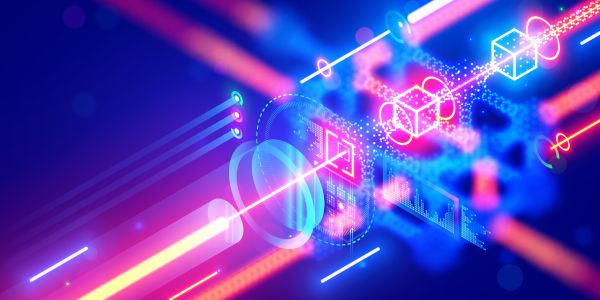
Classical computing relies on bits, which are like switches: on (1) or off (0). Simple, right? But the quantum world is a bit stranger. Quantum computing, on the other hand, uses qubits. These aren't just 0 or 1, but can be both at the same time, or somewhere in between. It's like having a switch that can be on, off, or in a "maybe" state until you look at it.
This ability to be in multiple states simultaneously is one of the things that makes quantum computers so different and potentially more powerful for certain types of calculations. We're talking about a real paradigm shift from how we've always thought about computation. Quantum computing is a complex field that leverages the principles of quantum mechanics to solve problems that normal computers can't handle.
Qubits: Beyond the Classical Bit
Imagine a classical bit as a coin lying on a table, either heads or tails. A qubit, however, is like a coin spinning in the air: until it lands, it's in a state of superposition, potentially both heads and tails. Only when we measure it does the coin "decide" to land on one side. This ability to represent multiple pieces of information simultaneously is what gives quantum computers their potential. It's not just about having more "space" for data, but about being able to explore many more possibilities in parallel. This opens up entirely new scenarios for solving complex problems.
Fundamental Principles: Superposition and Entanglement
Besides superposition, there's another strange phenomenon called entanglement. Think of two qubits connected in a special way. If you measure the state of one, you instantly know the state of the other, no matter how far apart they are. It's like having two gloves in separate boxes: if you open one box and find the right glove, you immediately know the other one must be the left glove. These two principles, superposition and entanglement, are at the heart of what makes quantum computing possible.
They allow quantum computers to perform calculations in ways that are simply impossible for traditional computers, paving the way for new computational possibilities.
The Quantum Revolution Underway
We are witnessing a true paradigm shift in computing, a generational leap that promises to rewrite the rules of the game. This isn't just an improvement on the computers we use today, but an entirely new approach to computation. This new way of processing information opens the door to solutions for problems that have so far been considered insurmountable. Think about discovering new drugs, managing complex financial portfolios, or creating innovative materials. The transformative potential of quantum computing is immense, and its influence will be felt in almost every sector. It's a bit like moving from the first vacuum tube computers to modern supercomputers, but with an even more significant difference.
Quantum mechanics, which has revolutionized our understanding of reality at the microscopic level, is now the foundation for this new technological era. Its counterintuitive laws, describing the behavior of elementary particles, are the key to building machines capable of exponentially more powerful calculations. We are talking about a transformation that will change the future as we know it, impacting scientific research, industry, and even our daily lives.
The ability to simulate complex systems with unprecedented accuracy is just one of the many aspects that make this revolution so exciting. It's a rapidly evolving field, and today's discoveries lay the groundwork for tomorrow's innovations, redefining the limits of what is computationally possible.
Quantum Mechanics: The Fundamentals
As we approach the world of the infinitely small, we realize that the rules we are used to no longer apply. Quantum mechanics was born precisely to explain what happens between particles like electrons, photons, and atoms. These particles seem to follow different laws than those we know in our everyday lives. For example, the way they move and interact seems random, but in reality, they follow precise patterns that we can only predict in terms of probability.
Precisely for this reason, probability theory is often mentioned when explaining how microscopic events work; some have even defined quantum mechanics as a sort of causal theory of probabilities (quantum as a theory of probabilities).
The Birth of Quantum Mechanics
At the beginning of the 20th century, scientists realized that classical physics was no longer sufficient to describe the phenomena observed in new research. Experiments like black-body radiation or the photoelectric effect seemed to violate the established laws.
Max Planck was the first to introduce the concept of the energy quantum: he hypothesized that light could not be emitted or absorbed in any arbitrary amount, but only in minimum packets. This starting point revolutionized everything and paved the way for others, like Einstein and Bohr, to build a new physics better suited to these microscopic oddities. In a short time, thanks to these advances, quantum mechanics became the primary reference for anyone wanting to understand the behavior of matter inside and outside atoms.
What are Energy Quanta?
The word quantum comes from the Latin "quantus," meaning "how much." In a scientific context, a quantum represents the smallest, indivisible amount into which a certain quantity, such as energy, can be divided.
In the quantum world, energy cannot be infinitely subdivided: it is absorbed or released only in these minimal packets. If we imagine energy as a set of steps rather than a smooth ramp, everything becomes clearer.
This discrete way of functioning is one of the most typical aspects of quantum mechanics, so much so that it forced physicists and mathematicians to change their mindset regarding what they believed possible only a few decades earlier. If you want a more conceptual in-depth look at the foundations and origins of quantum ideas, some have even tried to link these discoveries to major philosophical questions (foundations of quantum theory).
Key Quantum Phenomena
The Principle of Quantum Superposition
Imagine that a particle, like an electron, is not just in one place or another, but in all possible places simultaneously. This is the essence of quantum superposition. It's not like a coin spinning in the air that will be heads or tails when it lands; it's more like the coin is both heads and tails until you look at it.
Only when we perform a measurement does the particle "choose" a specific state. It's a strange concept, isn't it? But this is precisely what allows quantum computers to explore many possibilities in parallel.
Schrödinger's Cat Paradox
To try and convey how bizarre superposition was when applied to the world we know, physicist Erwin Schrödinger invented this thought experiment. Let's put a cat in a sealed box with a mechanism that could kill it, triggered by a random quantum event. According to quantum mechanics, until we open the box to check, the cat is both alive and dead at the same time. Obviously, in reality, a cat cannot be in two such opposite states, but this paradox helps us visualize how different the rules of the microscopic world are from those of our everyday world.
Entanglement: Connected Particles
Then there's entanglement, another mind-bending phenomenon. When two particles are entangled, they are linked in such a profound way that they share the same fate, no matter how far apart they are. If you measure a property of one particle, you instantly know the corresponding property of the other, even if it's on the other side of the universe. It's as if they have an invisible thread connecting them. This instantaneous connection is one of the most mysterious and powerful features of quantum mechanics, and it plays a significant role in technologies like secure quantum communication.
Practical Applications of Quantum Computing
Quantum computers are not just a theoretical concept; they are beginning to show their potential in very concrete fields. One of the most promising areas is molecular simulation. Imagine being able to accurately predict how a new molecule will react before even synthesizing it in the lab. This could enormously accelerate the discovery of new drugs, making research processes faster and cheaper. The ability to model complex systems at the atomic level is a true game-changer.
Besides medicine, optimization is another sector that will greatly benefit from this technology. Think about logistics, supply chain management, or financial markets. Quantum computers could find the best solutions to problems with an almost infinite number of variables, something that current computers struggle to handle. This means more efficient routes, smarter investments, and better resource allocation.
There's also a security aspect to consider: the advent of powerful quantum computers could render many of the encryption methods we use today to protect our information obsolete. We're talking about a true revolution for cybersecurity and the protection of sensitive data. Research is already underway to develop new algorithms resistant to quantum attacks, a field known as post-quantum cryptography.
The impact is vast and touches almost every aspect of our digital and industrial lives.
The Future of Quantum Computing
The future of quantum computing is already before our eyes. We are in the midst of a transition phase where quantum computing is moving from research labs to the first working prototypes and industrial experiments, including at the Italian level. The difference compared to the past will be made by photonic quantum computers, the ambitious roadmaps of major players like IBM, and the convergence with artificial intelligence. We may soon see habits, jobs, and research radically transformed, even far from specialized physics centers. It's a silent revolution of historical significance: today, the foundations are being laid for the future way of thinking about and using technology.
Frequently Asked Questions
What exactly is a quantum computer?
Imagine a normal computer that uses switches that can only be on (1) or off (0). A quantum computer, however, uses something called a 'qubit'. A qubit is special because it can be 0, 1, or a combination of both at the same time! This allows it to perform much more complex and faster calculations for certain problems.
What is the difference between a bit and a qubit?
A classical bit is like a light switch: it can only be on or off, so it represents 0 or 1. A qubit, on the other hand, is like a dimmer switch: it can be completely off, completely on, or anywhere in between. It can represent 0, 1, or a kind of 'mix' of both simultaneously, thanks to a phenomenon called 'superposition'.
What do 'superposition' and 'entanglement' mean?
'Superposition' is when a qubit can be in multiple states (0 and 1) at the same time, a bit like a coin spinning in the air before it lands. 'Entanglement' is even stranger: it's when two or more qubits are linked in such a way that if you know the state of one, you instantly know the state of the other, no matter how far apart they are. It's like having two magic dice that always show the same number, even if you roll them in different rooms.
Why are quantum computers so important for the future?
They can solve problems that normal computers would take billions of years to solve! This means they could help us discover new medicines, create revolutionary materials, make finance more efficient, and even improve artificial intelligence. It's a technology that could change the way we live and work.
Are quantum computers a threat to online security?
Yes, in a way. Many of the security systems we use today to protect our information (like passwords) are based on mathematical problems that current computers find extremely difficult to solve. A powerful quantum computer could solve these problems very quickly, making these systems insecure. That's why work is underway on new forms of 'quantum cryptography' to protect us.
When will we be able to use quantum computers in everyday life?
We won't see them in our homes soon like laptops. They are huge, complex, and expensive machines that require special conditions (like extremely low temperatures). However, companies and researchers are already using remote quantum computers to conduct experiments and solve specific problems. The real revolution for everyone might still take several years, but progress is very rapid!